
Understand Livingston Deed Records
A Livingston County deed does several jobs at once. It names the grantor who conveyed and the grantee who received. It states the consideration and sets out the legal description of the land. Signatures and a notarial block make it recordable. The instrument may cite a prior deed, a parcel number, a plat, or restrictions that run with the property. The deed type matters, of course. The actual language inside the recorded deed records still carries more weight. No label on the outside can match it.
| Deed form | What it does | Typical Livingston use |
|---|---|---|
| General warranty | Conveys the stated interest with broad warranties | Ordinary arms-length transfer |
| Special warranty | Limits warranties to the grantor's acts | Transfer with narrower protection |
| Quitclaim | Conveys whatever interest the grantor has | Interest cleanup or family transfer |
| Executor or fiduciary | Transfers through authorized estate action | Estate administration |
| Master commissioner or sheriff | Records a court-directed or sale-related transfer | Judicial or delinquency trail |
| Correction deed | Corrects identified text in an earlier instrument | Name or description correction |
Mortgages, liens, easements, releases, and plats often sit in the same indexes as Livingston County deed records, yet not every instrument conveys ownership. Read the stated effect of each one before drawing conclusions.
Livingston Clerk Coverage Since 1795
The Livingston County Clerk Legal Records Department describes most legal records as running from 1795 to the present. The details differ, though. Most indexes reach only to about 1880, with exceptions. Online instrument images are generally described as available from January 1795 onward. Those are three different claims. A very early image may exist even when the matching index route is hard to use.
Confirm the specific book, page, index, and image before assuming full online access. Livingston County formed from Christian County in 1799. A chain running earlier than county formation can lead into the predecessor county's deed records. The local coverage statement does not change that.
Note: Treat coverage claims as starting clues, then verify the exact volume and instrument with the Clerk.
Walk Livingston's Grantor-Grantee Chain
A grantor-grantee index works both directions. Search the current owner of record as grantee. That finds the deed that conveyed the parcel. That document names the prior grantor. Search that earlier owner as grantee in a still older span. Then repeat the walk backward while logging each recording reference. Along the way, confirm the legal description stays tied to the same tract. Acreage splits and plat changes can redirect the chain.
- Start with the current qPublic parcel and latest known owner, then locate that name as grantee.
- Open the deed and capture grantor, grantee, date, deed form, legal description, and book/page or instrument number.
- Search the grantor as an earlier grantee. Use spelling variants, initials, co-owners, and a wider date range when needed.
- Follow corrections, probate papers, affidavits, and plats referenced along the chain.
- Move to deed books, archives, or Christian County sources when the Livingston trail crosses the online index or county-formation boundary.
- Grantor
- The party conveying an interest.
- Grantee
- The party receiving the stated interest.
- Chain of title
- The linked sequence of instruments for the same land.
- Book and page
- A volume locator for a recorded document.
- Instrument number
- A unique recording reference used to retrieve a filing.
Use eCCLIX or the Counter
Remote research runs through eCCLIX. The service requires an account and password assigned through the provider, and it charges fees for access. The county workspace fields and plan pricing are not published on the county page. Check with the provider rather than assuming every image is included.
The counter route is different. Public records and indexes can be viewed free at the Clerk's counter. The counter sits at 321 Court Street in Smithland. Hours are Monday 8:00 to 5:00 and Tuesday through Friday 8:00 to 4:00. A researcher without remote access can bring names, parcel numbers, date ranges, and known references to the counter.
| Route | Access | Best use |
|---|---|---|
| eCCLIX | Account-based, fee-bearing | Remote index and available image work |
| Clerk counter | Free public viewing | Indexes, public records, and staff-directed retrieval |
| Open-records request | Hand, mail, fax, or policy email | A specific record not easily retrieved |
Find Livingston Plats and Easements
A chain is not finished just because each owner name links to the next. Check the plats, easements, restrictions, releases, affidavits, corrections, mortgages, assignments, and liens that a deed cites. Also pull anything filed during the ownership period. Brief legal summaries online cannot reproduce those terms.
The Clerk's forms and records pages confirm that many related instruments share the same office. For a subdivision tract, record the lot and block, the plat book and page, and road dedications. Note the common areas, access strips, and restriction references too. For rural land, preserve acreage, watercourses, roads, adjoining owners, and the prior-deed calls.
Livingston Deed Recording Costs
The published recording schedule lists a deed at $50. A real-estate mortgage runs $80. A mortgage with assignment costs $126. An easement or plat runs $50 each. A release, mechanic's lien, or lis pendens runs $46. Page overages of $3 apply beyond stated limits for many filings.
These figures are recording fees, not a universal copy-price list. The schedule publishes no general certified-copy fee. Confirm cost and format with the Clerk before ordering. The open-records policy separately lists ordinary noncommercial copies at $0.50 each. It adds other media, postage, and applicable statutory charges paid in advance.
Monitor New Livingston Filings
The Clerk offers DOC ALERT at no charge. Enroll a personal or business name. The system sends notice whenever a deed or mortgage bearing that name is recorded in Livingston County. It is a useful early warning. It is not a guarantee. Liens, aliases, legal descriptions, and unrecorded interests can slip past any name-based alert.
Treat each notice as a prompt, not an answer. Pull the instrument itself. Read the parties, the legal description, the notarial block, the recording reference, and any prior-document citation. Name collisions happen, especially with common surnames or businesses sharing a name.
Follow Livingston's Early Deed Books
Livingston County's recorded land story starts long before any online portal. The Kentucky Secretary of State's land-record bibliography lists Brenda Joyce Jerome's abstract of Deed Books A through C. The abstract covers 1800 through 1817. Treat that published work as a finding aid only. It can point you toward an early party or tract. Compare the citation against the original deed-book image or a Clerk copy before relying on it as the record itself.
Courthouse documentation from the era names Deed Book GG and Deed Book 2. It also lists Court Order Books D, I, J, and L. Circuit Order Books N and Q appear alongside Clerk Papers Box 14 from 1853. Those precise series explain why a vague request for all old deeds rarely works. When you contact KDLA, the Clerk, a library, or a historical society, give the book, page, date, names, road or watercourse, and the modern parcel link when known.
Livingston County formed from Christian County in 1799. An old Livingston deed may cite an even earlier grant or transfer. Record that reference first. Then search the predecessor jurisdiction. Kentucky tax lists can bridge the gap, though KDLA warns they are usually unindexed and arranged by district and landowner surname.
Connect Livingston Deeds and Estates
A tidy purchase-to-purchase chain can snap. That happens when land moved through a will, probate order, affidavit, executor's deed, death documentation, or a court-directed sale. Search the deceased owner's name. Also search the estate name, the fiduciary, the heirs, and the parcel's legal clues. Then match the court or probate reference to the deed. That deed placed the next grantee in the land record.
The Livingston Circuit Court Clerk can help at the Justice Center. The office can locate an available case file. CourtNet supplies a starting index for many cases. KDLA and local collections add older wills, estate papers, newspapers, cemetery files, and obituaries. Those sources may explain why a transfer happened, but the recorded instrument supplies the legal-description trail. Keep each person's role intact. Whether executor, commissioner, sheriff, trustee, or heir, the role matters. Avoid flattening everyone into an ordinary seller.
Note: When an owner vanishes from the deed sequence, search probate and court records before assuming an index entry is missing.
Order a Livingston Deed Copy
Pick the copy route that fits the need. View an available image through eCCLIX. Inspect it at the free courthouse counter. Or send a specific written request. The Clerk's open-records form asks for requester information and the records sought. It also covers purpose and residency choices, a signature, and the date. Under the policy, a determination or notice arrives within five working days, excluding weekends and legal holidays.
A useful request spells out party names and document type. It also lists a parcel or legal clue, date span, and book/page or instrument number when known. The forms page states that forms requiring an original signature must be mailed or delivered, not emailed or faxed. Ask whether a plain or certified copy suits your purpose before paying.
The Livingston County Clerk forms page is the official source. Use it for available request and land-record forms.
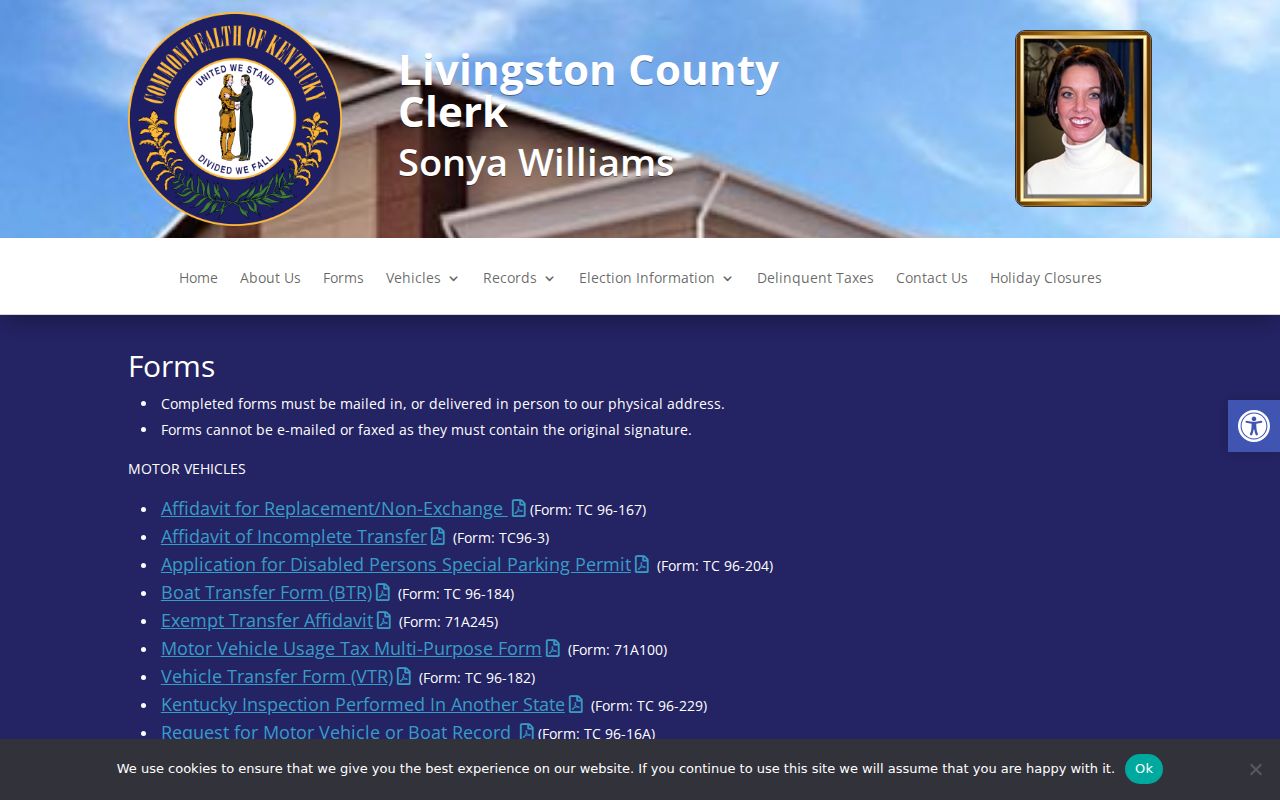
The Clerk's forms page displays the available request and land-record forms. That helps identify the right route for a deed copy. The Clerk should still confirm one point: plain or certified. Ask what charge applies too. A written open-records request should name the grantor or grantee. It should also list the instrument type, parcel or legal clue, date range, and book/page or instrument number.
The Clerk's policy accepts hand delivery, mail, fax, and email. It calls for a determination or notice within five working days. Fees and postage are paid in advance. Keep the request, response, receipt, and copy together so the source trail stays clear.
Recorded, not guaranteed. Livingston County deed records show what reached the Clerk; they are not a title opinion and do not rule out unrecorded interests.